

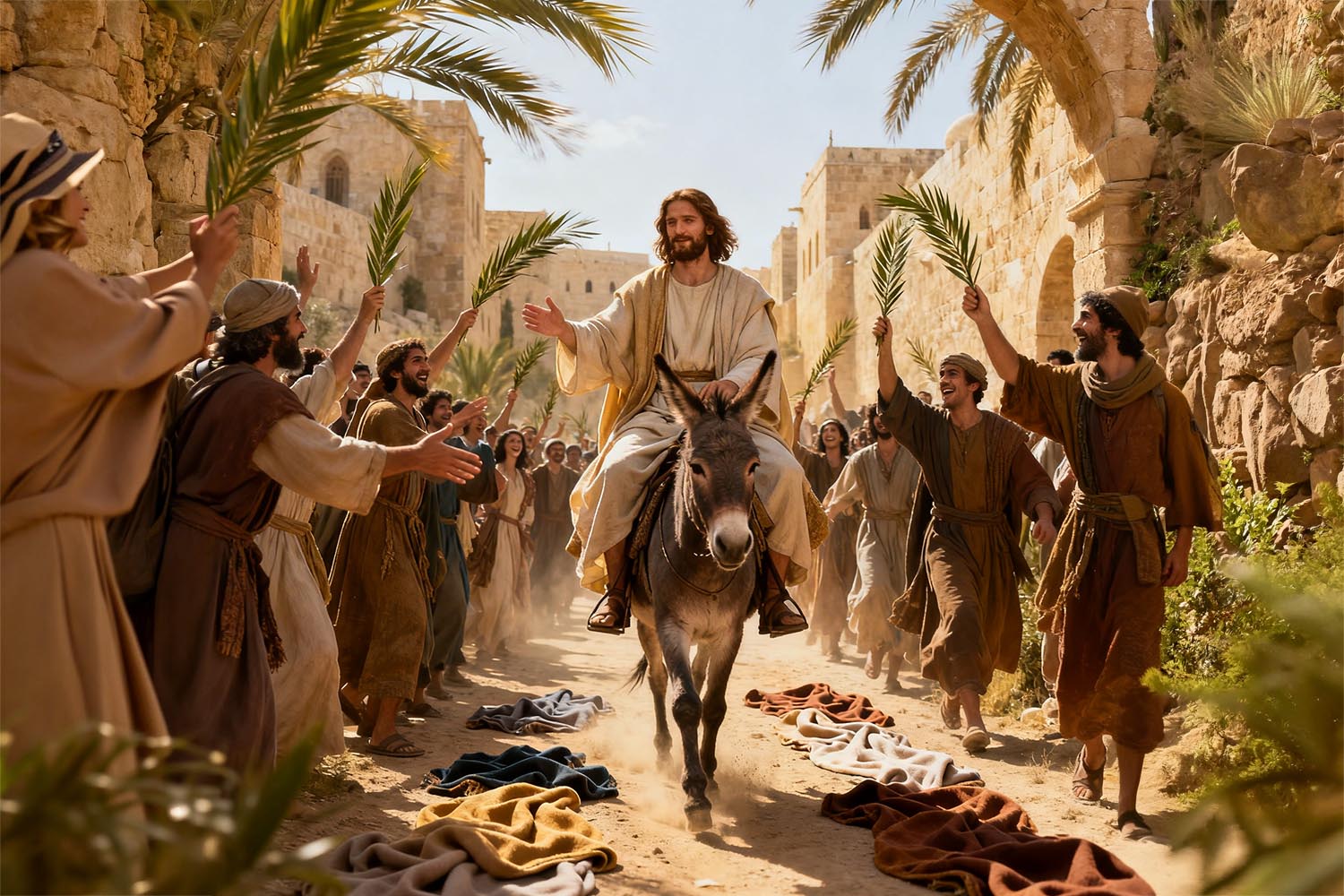
‘As they approached Jerusalem and came to Bethphage on the Mount of Olives, Jesus sent two disciples, saying to them, “Go to the village ahead of you, and at once you will find a donkey tied there, with her colt by her. Untie them and bring them to me. If anyone says anything to you, say that the lord needs them, and he will send them right away.”
This took place to fulfill what was spoken through the prophet:
“Say to Daughter Zion, ‘See, your king comes to you, gentle and riding on a donkey, and on a colt, the foal of a donkey.’”
The disciples went and did as Jesus had instructed them. They brought the donkey and the colt and placed their cloaks on them for Jesus to sit on.’ Matthew 21:1-7 (NIV)
This is the story of Jesus riding into Jerusalem on a donkey, often called the ‘Triumphant Entry.’ The fulfillment of the Old Testament prophecy given in Zechariah 9:9.
“Rejoice greatly, Daughter Zion! Shout, Daughter Jerusalem! See, your king comes to you; righteous and victorious, lowly and riding on a donkey, on a colt, the foal of a donkey.” Zechariah 9:9 (NIV)
Expectations of the Messiah in Jesus’ Time
For context purposes, during the time of Jesus and during his ministry, the Jewish people of the time were living under oppressive Roman rule and oppression from the religious leaders. Many were indoctrinated to believe that when the Messiah came, he would come as a military and political leader. One who would overthrow the Roman Empire’s occupation and re-establish the kingdom of Israel.
Many of Jesus’ own disciples held this fundamental belief as well. Which is why, in the previous chapter of Matthew, the mother of James and John asked that her sons be placed at Jesus’s right and left sides (Matthew 20:21). In other words, the mother of James and John asked Jesus to place her sons as second-in-command. It was their belief, James and John’s and hers, that Jesus, as the Messiah, would overthrow the Roman Empire and restore the kingdom of Israel. They assumed that Jesus would lead a holy war against the Roman government and rule. Unbeknownst to them, God’s plan for Jesus was not to restore the physical kingdom of Israel. Instead, God’s plan was to establish his kingdom, a spiritual and eternal kingdom. To do so, certain things needed to take place before this could become reality: the sacrifice and resurrection of Jesus Christ. To not only make way for believers to enter the kingdom of heaven, but also to restore the connection lost when sin first entered through mankind. As humans, we are all sinners designated so by the original sin of Adam and Eve. In the time before Christ’s death and resurrection, we not only had no justification for our sins, but our connection to God was broken. Thus, we had to participate in the sacrificial laws spoken of in Leviticus. It is through Jesus Christ, our faith and belief in him, that we are made pure and blameless before the throne of God. Forgiven of our sins and bridging the gap that sin made to restore our connection to God. Through Jesus, we are given the gift of salvation and eternal life by the covering of our sins. Through the sacrifice of Jesus, we no longer have to atone for our sins through animal sacrifice. As Jesus was the final sacrifice, fulfilling the law and prophecy. Instead, we come to God directly to ask for forgiveness.
‘And all are justified freely by his grace through the redemption that came by Christ Jesus.’
Romans 3:24 (NIV)
Misunderstanding the Role of the Messiah
As stated previously, many people during Jesus’ ministry believed he would appear as a military and political ruler. Which, among other things, sparked speculation among certain groups about his authenticity as the Messiah. As told in the Old Testament, the messiah would come from the line of David. Jesus was born of the line of David, but many interpreted this to mean that, because David was a physical king, so too would the Messiah. Others interpreted these scriptures and took it upon themselves to believe that he would come as a priest, a prophet, or a judge. Believing he would come into the picture with societal standing and royal authority by earthly human standards. Holding these beliefs, as well as others, prevented people from seeing beyond their own perspective. It prevented people from seeing outside of what they had been taught to believe. They were close-minded to the reality of who Jesus the Messiah was. What many failed to understand at the time was that the messiah was not going to come as a ruler of men, but as the savior of man. John 3:17 states, ‘For God did not send his Son into the world to condemn the world, but to save the world through him.’ God did not send Jesus to lead a war or to overthrow worldly rulers. He has no purpose for worldly ruling, as his kingdom is spiritual. God sent Jesus into the world to save it; to bring peace, salvation, and forgiveness. To dethrone Satan and his rule over humanity, his claimed authority, which was obtained through the sins of Adam and Eve. Jesus’ mission was to save humanity, to dethrone the authority Satan had and the hold of sin over humanity. Jesus’s conquest of death and sin stripped the enemy of every power and authority he was given. It was never a physical war, as many people of the time assumed it would be. It was and continues to be a spiritual war.
The Question: Why a Donkey?
Throughout my life in church, it was always taught that Jesus riding into Jerusalem on a donkey was a sign of Christ’s Humility, but I had never been given any context as to why. A few of the many questions I have always had about the story of Jesus riding into Jerusalem on a donkey were: why? Why did he choose a donkey? And why was this symbolic of Christ’s humility?
Horses and Donkeys in Biblical Culture
To better understand the why, we first need to look at the functions and roles of horses and donkeys in biblical times. During the Roman Empire, as in many other empires before it, horses were reserved for the royal family, high-ranking political figures, and the military. They were symbolic of authority and power, as they were used to transport the emperor and elite politicians, and for use in and during war. Horses were a symbol of wealth, luxury, pride, military might, and power. They were considered only for those of high status and wealth. Often, horses used to transport the wealthy and elite were dressed in fine cloth. Those that were used for military purposes were dressed in expensive armor. Horses were often paraded through the streets by the wealthy in a show of force and power. Donkeys, on the other hand, were used in agriculture and the transportation of goods. Often called ‘Beasts of Burden’, used for labor and work. Carrying heavy loads of goods in service to humans with persistence, endurance, and strength. Unlike horses that were dressed in fine cloth and armor, donkeys were often only harnessed by simple hand-woven rope. In this context, the donkey symbolizes Christ; God humbling himself before humanity, becoming human to do the work on the cross of bearing our burden of sin so that we might be saved. Carrying the load of our sin with strength, unfailing endurance, persistence, and selfless sacrificial service. Jesus didn’t come into Jerusalem dressed in expensive attire and armor, parading his wealth through the streets. Instead, Jesus came dressed as a commoner, gifting and sharing his spiritual wealth with the people.
The Message Behind the Donkey
When Jesus rode into Jerusalem on a donkey rather than a horse, it was a strategic, bold, and symbolic message. Bringing salvation through love and sacrifice, instead of bringing salvation through conquest and war. A symbolic message that Christ came to work as a humble servant for the salvation of humanity, not to rule over it. Christ didn’t come to conquer worldly kingdoms and reigns, but to conquer the kingdom of darkness and the hold that sin had over humanity. Jesus did this through love and sacrifice. Christ came to carry our heavy load of sin, like donkeys carried loads of heavy goods. It’s a message to all who saw and heard of it that God did not send Christ the Messiah to wage war on humanity but to save and redeem it. Jesus came to save all people, not just those of the Jewish faith. Through Christ’s work and labor on the cross and through his resurrection, we all have the choice of salvation. Christ could have easily chosen to ride into Jerusalem on the back of a horse, because he was and is of the highest authority. But our understanding of authority comes from human interpretations and worldly views of wealth and power. The people were holding Jesus to human standards, which, by all accounts, are unequal to God’s standards. So, instead Christ chose to ride into Jerusalem on the back of a donkey, as foretold in the book of Zechariah. Humble before humanity to do the work through his ministry and on the cross for the purpose of our salvation and redemption. The mission was designated to him by the will and standards of God Almighty. A redefining moment that differentiated human standards from God’s standards.
The Crowd Welcomes the King
‘A very large crowd spread their cloaks on the road, while others cut branches from the trees and spread them on the road. The crowds that went ahead of him and those that followed shouted,
“Hosanna to the son of David!”
“Blessed is he who comes in the name of the Lord!”
“Hosanna in the highest heaven.”’
Matthew 21: 8-11 (NIV)
The Meaning of Laying Down Cloaks
When the people in the crowd laid their cloaks out on the road for Jesus, they weren’t just rolling out the grand welcome mat. In ancient Eastern traditions, laying cloaks or spreading out garments on the ground for someone was a symbolic act of submission. It was an act of bestowing honor and acknowledgment of his authority. Something that was only done in ancient tradition for kings. Another example of this can be found in 2 Kings, after Jehu was secretly anointed as king by the son of the prophet Elisha.
‘They quickly took their cloaks and spread them under him on the bare steps. Then they blew the trumpet and shouted, “Jehu is King!”’ 2 Kings 9:13 (NIV)
Garments, especially outer garments, were considered valuable possessions due to the labor, time, and cost involved in producing them. They were a symbol of economic and social status. While many individuals of high status and wealth owned several garments or cloaks, most people in the general population only owned one. For the average person, their cloaks were the only things they possessed that were of significant value. When the crowd laid their cloaks on the road ahead of Jesus, they were submitting to his authority as the Messiah. Acknowledging him as the promised king and savior. Laying down their cloaks, one of their most prized possessions. It symbolized that even though the people had little to offer, they gave everything that was of great importance to them. A humble reminder that it doesn’t matter the amount we have, but the willingness to give what we value most, the best of what we have in service and sacrifice to God. After all, in the end, it belongs to him anyway.
The Meaning of “Hosanna”
When the crowd went before him, announcing his presence and shouting ‘Hosanna, the son of David!” “Blessed is he who comes in the name of the Lord!” “Hosanna in the highest heaven!” The word Hosanna in ancient Hebrew was often used and depicted as a desperate plea by people crying out to God for him to save them. Common translations include “save us” and “deliver us.” In this instance, it wasn’t just a desperate plea for salvation and help, but also a way to bring praise to God in heaven. In other words, it was a praise to God in heaven for sending their salvation. Jesus Christ, our deliverer and the one who saves.
God’s Humility in Christ
God in the flesh, Jesus Christ, chose to come into the world as a man in humble sacrifice and service to save humanity. Born in a manger and later becoming a carpenter before beginning his ministry. Jesus shows us that God does know what it is like to be human. To live in the world, not as a king born into wealth and status, but as a child born in a manger into the life of the working class. Rightfully, he could have placed himself above the common man in a position of authority. Instead, he chose to align himself with the common man. An expression of the immeasurable amount of sacrificial love he has for us. It’s clear that God does not want people to love him by force or under a worldly authority. Instead, he wants us to choose to love him and choose to follow him. Which is why we were given free will, so that we might choose to love him. All the while, God knew that not everyone would choose him. He doesn’t want us to love and follow him out of tradition or indoctrination. Not because it’s what we’ve been taught to believe, but purely out of personal choice and recognition of his authority. The only one who conquered sin and death. The one who saved humanity and adopted us into his kingdom as his own. The one who stripped the enemy and his dominion of their authority and power. And the one who will one day return for his people, not as a humble servant but as the King of Kings. Coming with power and authority to wage war on Satan and his demons in a final battle.
The Future Return of Christ
“I saw heaven standing open and there before me was a white horse, whose rider is called Faithful and True. With justice he judges and wages war. His eyes are like blazing fire, and on his head are many crowns. He has a name written on him that no one knows but he himself. He is dressed in a robe dipped in blood, and his name is the word of God. The armies of heaven were following him, riding on white horses and dressed in fine linen, white and clean. Coming out of his mouth is a sharp sword with which to strike down the nations. “He will rule them with an iron scepter.” He treads the winepress of the fury of the wrath of God Almighty. On his robe and on his thigh he has this name written:
‘KING OF KINGS AND LORD OF LORDS.’”
The Meaning of the White Horse
As we know from previous paragraphs, horses represent authority, power, and military might in the biblical context. White horses in the Bible are specific, not just symbols of military might and war, but also of conquest. Such as the white horseman spoken of in Revelation 6. In the flesh, Christ came as a humble servant to save humanity from sin. But when he returns, he won’t come as a humble servant but will come with the authority of God and heaven as the king of kings to eradicate sin and evil once and for all. He will come on a cloud in Triumphant victory, clothed in righteousness and authority for all to see. Leading the charge to eradicate evil with the army of heaven behind him. He won’t come back the same way he entered the world through the sounds of a crying infant born in a manger, but through the thundering sounds of heaven as the roaring lion of Judah and king of kings. The return of Jesus won’t be a quiet event in any aspect, not physically or spiritually. Christ’s return will be heard and seen by all who dwell on the earth. The final battle that takes place with the return of Christ won’t be won through military might, but through the authority of his spoken word. Just as creation was spoken into existence by the word of God. And as Jesus stated, “it is finished” on the cross before his death in declaration of victory in his mission. So too will evil and sin be taken out of existence by the spoken words of God.
‘Coming out of his mouth is a sharp sword with which to strike down the nations.’ Revelation 19:15 (NIV)
Thus, concluding the ultimate war between good and evil that has spanned thousands of years and generations. Not won through military might, but through his spoken word. The cataclysm that sin has caused will be eradicated, and a new heaven and new earth will be established. A glorious and righteous victory for the Kingdom of God.
Avoiding the Mistakes of the Past
Just as the people in biblical times believed the messiah would come into the picture as a physical king. As believers, we cannot be close-minded about what it will be like when Jesus returns. Rather, we need to read the scriptures for ourselves with assistance, direction, and help from the holy spirit for interpretation and understanding.
Understanding the Message of the Donkey
The story of Jesus riding into Jerusalem on a donkey is an important and powerful historical moment for many reasons. Not just the fulfillment of prophecy but also the detailed symbolism behind why. In our modern-day society, many things are vastly different from the times when Jesus walked the earth as a human. In contrast, there are also many similarities. Such as the continued implementation and reality of principalities, societal standards, wealth, and power. While these things remain the same, the detailed picture of it is packaged differently with a new futuristic face. Satan has no hold over the minds and spirits of believers, but he is still very much active today as he was thousands of years ago. Much of the fear and principalities that ruled in biblical times are still at play in our world today. The story remains the same: a society concerned with wealth and power. Indoctrinated by those in control to believe in one perspective. We live in a modern society that still shows contempt for the idea that what we have been taught to believe may not be true. So, like the thinking of those in biblical times who assumed the Messiah would come as a physical king. We, too, can be set in our ways and closed-minded in our thinking about the end times and the return of Christ. The truth of the matter is that no one really knows for sure what the reality of Christ’s return will look and be like. So let us take a lesson from the people of that time, not to be close-minded. Rather, to be open-minded to the reality of the return of Christ.
The Deeper Meaning of the Donkey and the King
The story of Jesus riding into Jerusalem on a donkey isn’t about physical wealth and power. It’s the foretelling of the story of the power of God’s love, grace, mercy, and redemption of humanity through Christ. Christ was never concerned with the appearance of man, but with the hearts of men. Physical wealth, in its abundance, if left unchecked, can be an insatiable beast. Infused with greed that can never be fed to fulfillment. On the other hand, spiritual wealth offered to everyone by God is more fulfilling than any physical wealth or power. Christ knew that physical wealth can often lead to greed if left unchecked. This is one of the many reasons he came as a man not of wealth and status, but as a humble servant who gifted his spiritual wealth. Emphasizing that our wealth is not of earthly value, but is spiritual wealth stored in heaven. It isn’t just the big picture that matters in the stories of the scriptures; it’s also the intricate details and symbolism God uses. God is within the details as much as he is within the big picture. Everything written and recorded in the Bible was done intentionally. Having a background understanding of daily life, societal functions, and religious norms in biblical times helps us better understand the context of scripture. It helps us to better grasp the symbolic meanings that lie behind the scenes. It guides us into a better understanding of the character of God, Jesus Christ, and the Holy Spirit. Simultaneously strengthening our relationship with Christ.